You have seen “if you stare into the abyss, the abyss stares back” on a gym poster, in a movie, and in a comment section that had nothing to do with philosophy. Nobody tells you what it was attached to, so the stare into the abyss meaning you carry around is whatever the last scene taught you. I met it that way, in movies and TV, long before I knew it came from a book. This post puts the line back where it came from, shows how pop culture bent it, and then gives my own reading, which is one of several.
The Stare Into the Abyss Meaning in Nietzsche’s Original Quote
The line comes from Beyond Good and Evil, aphorism 146, published in 1886, inside a section of short maxims. That is the first thing the poster leaves out. It was never a standalone motivational line. It was one sentence in a pile of compressed observations meant to make you think, not to make you feel better.
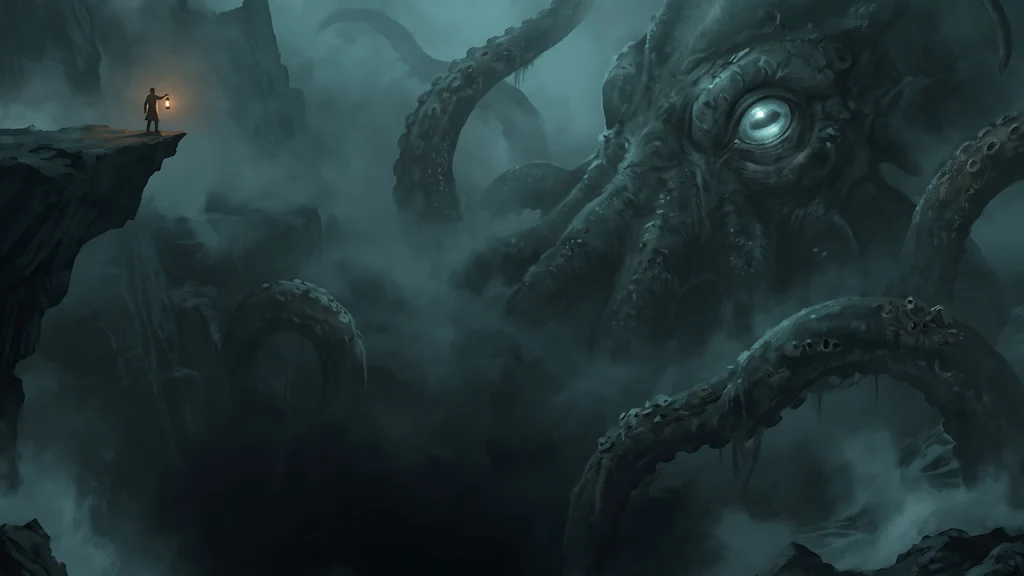
The second thing the poster leaves out is the sentence right before it. Nietzsche opens by warning that whoever fights monsters should take care not to become one. Then comes the part everyone knows: if you gaze long into an abyss, the abyss also gazes into you. Read together, the abyss is not scenery. It is what a long fight leaves in the fighter.
Translators did not agree on the verb either. Zimmern and Hollingdale say gaze, Kaufmann says look, and the version that spread through pop culture says stare. That is why you see “gaze into the abyss” and “stare into the abyss quote” treated like two different quotes when they are one sentence in different translations. The Nietzsche abyss quote you remember depends on which book, film, or caption you met first.
The same thing happened to another Nietzsche line. I broke down what “what doesn’t kill you makes you stronger” actually meant, and it got the same treatment, a comfort on the outside and a standard on the inside. Different quote, same stripping, which is the reason posts like this exist.
He Who Fights Monsters Should Take Care Not to Become One
He who fights monsters is the half that gets cut, and it is the half that explains the other one. The warning is about an enemy you fight for so long that you start to fight like them. You do not wake up one day as the monster. You pick up one habit at a time, each one justified by what you are up against, until the habits are the whole person.
That slow slide is the part I keep coming back to. It is how small violations turn into systemic rot, and it is why you rarely feel yourself become the monster. Every step looks reasonable from the inside. It only looks like a line crossed when you are standing on the far side of it.
Becoming what you hate works the same way, just with a personal target instead of a villain. You stay so locked on what you refuse to be that you build your whole behavior around it. Then the thing you refused is steering anyway.
How Pop Culture Turned the Abyss Into a Dare
Pop culture took the second half, dropped the first, and turned it into a dare. In most scenes where the line shows up, someone looks into the dark and the dark looks back as proof they were brave enough to look. That is a poster reading. It treats staring into the abyss as the achievement, when Nietzsche treated it as the cost.
Watchmen is the cleanest case I know of where the line does its actual job. The comic titles Rorschach’s chapter The Abyss Gazes Also, and the one doing the gazing is the psychiatrist assigned to him, Dr. Malcolm Long. A man who sets out to examine a monster ends up being examined, and the abyss gazes back at him. I have not read the comic, it is too morbid for me, and I only saw the movie. That movie is fucked up, and it still carries the same idea, with Rorschach telling the inmates who come at him that he is not locked in with them, they are locked in with him.
That reversal is the whole quote in one move. The one who thinks he is looking is the one being looked at. Once you see it that way, you start noticing it in every story where somebody gets too close to the thing they are supposed to be handling.
Keep It Hidden and It Bites Back
My reading comes from the other direction. Nietzsche warns about looking too long. I think the more common mistake is refusing to look at all, and my version is simple: keep it hidden and it bites back.
Whatever you shove out of sight does not leave. It runs from there, quietly, and it shows up as the short temper, the fatigue, the shutting down, and the thing you snap at someone over that had nothing to do with them. I wrote about where men put their pain, and the pattern is the same: it does not disappear, it relocates. The abyss does not need you to stare at it to look at you, because it was already in the house.
That is one reading, and I know it is not the only one. A line this big gets taken a dozen ways depending on who is reading it, and the gym poster version is just the narrowest of them. What matters is that you check the version you are carrying against what the line was attached to. Mine comes from watching a lot of movies and a lot of comic book characters deal with exactly this.
Three Ways the Abyss Looks Back
Three characters show the possible outcomes better than any quote can. Batman looks and holds the line. Rorschach looks and crosses it. Wolverine never chose to look, and it is in him anyway. They are grounded enough to feel real, which is why they work for this.
Batman: Looks and Holds the Line
Batman has spent his whole life fighting a monster who keeps looking back at him, and the Joker is as close as fiction gets to the abyss with a face. The scene that says it best for me is in Under the Red Hood, where Jason Todd asks why he never just crosses the line and kills him. Batman’s answer is that crossing it would not be hard, it would be too easy, and once he did he would never come back.
That is the first half of Nietzsche played out in two sentences. He knows exactly what the fight could turn him into, and he treats the line as the only thing keeping him on the right side of it. The strength is not in the punching. It is in refusing the shortcut that would make him the thing he fights.
Rorschach: Looks and Crosses It
Rorschach is what is left when the line is gone. He fought the worst of what he saw for so long that the fight became his entire personality, and there is nothing under the mask for the abyss to look at except more abyss. He does not get to put it down at the end of the day, because there is no day that is separate from it.
This is why he sits at the center of the quote. Dr. Long is the person looking and getting changed. Rorschach is the person who became the thing, so between them you get both the cost of staring and the cost of what was staring first.
Wolverine: Never Chose to Look
Wolverine is the one that does not fit the quote, and that is why he matters. Nietzsche’s warning assumes you chose to stare, and nobody asked Wolverine. He is over a hundred years old, a lot of what shaped him was done to him, and he does not even know all of it.
He is the best at what he does, and what he does is not nice. That is the line, and it is also the confession. He is afraid of his own berserker rage because the thing that takes over is not a stranger, it is him with the brakes cut, and the harder he locks it down, the more it matters when it breaks loose.
That is hidden and biting back in its purest form. He cannot even look at it properly, because the people who experimented on him also messed with his memory. You can carry an abyss you never asked for and never fully saw, and for a lot of people that is the real situation.
Looking Costs You, and So Does Hiding
Nietzsche’s version is real. Stare at anything ugly for long enough and you stop feeling it, which is desensitization, or you start seeing it in everything, or you loop on it until it turns into rumination. That is the cost of looking too long, and it is why the warning exists.
The cost of hiding is the one the poster never mentions. If looking changes you and hiding bites back, you are not choosing between a safe option and a dangerous one. You are choosing which cost you can see coming.
The practical read is smaller than the quote makes it sound. Look at the thing, name it, and then put it down. Do not stare at it for years, and do not pretend it is not there.
What the Abyss Is Asking You
The abyss meaning that holds up is not a dare and not a threat. It is a bill that comes due either way, whether you stare too long or look away too hard. What you carry out of it is the version you checked against the source instead of the poster, and if you recognize the hiding half in yourself, start with why holding onto anything, even something small, blocks your growth.