My seventh grader can solve for x. She struggles to add 25 and 50 without stopping to work through the steps. That gap isn’t a math problem, it’s a reps problem, and no list of mental math tricks fixes it.
Watch her do it and the friction is obvious. She lines the numbers up the way school taught her, works the right column, checks whether she needs to carry a one, then works the left column. It’s correct every time. It’s also slow, because the method was built for paper, not for a head doing math on the fly. I can get to 75 before she’s finished checking her carry column, and I never learned a trick for it. I just never learned the paper method as my default in the first place.
Why Mental Math Tricks Don’t Actually Stick
Most mental math tricks are patches applied to a method that was never built for speed. They teach you to recognize a number pattern and apply a shortcut to it. That’s fine as far as it goes, but it’s memorization dressed up as intuition. The moment the numbers fall outside the pattern, the trick is gone and you’re back to the slow method underneath it.
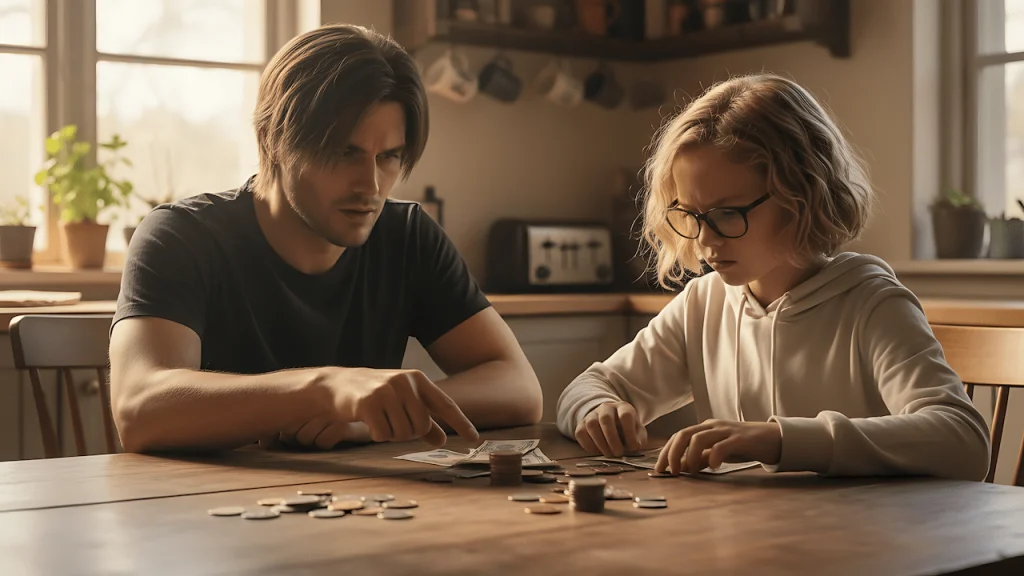
What I use instead is a different default, built from handling actual money as a kid on a limited allowance. Growing up in the Philippines in the 90s meant learning denominations that don’t exist anymore, a two peso bill, a five peso bill, a five hundred peso bill that was once the biggest note in circulation. Budgeting that allowance for years taught me to round to friendly numbers instead of stacking digits. ₱14.75 + ₱15.25 isn’t a carry-the-one problem if you’re thinking in money, it’s two amounts close to a clean ₱30, and the answer lands fast because your brain is already counting in denominations. That’s how to count money fast, in practice: not a trick, just enough reps that the rounding became automatic.
Formal math never gave me that, which is odd given my own major. I hated most of my college math: Algebra, Analytic Geometry, Trigonometry, Calculus. Numerical Analysis and Discrete Mathematics were the exceptions, and both clicked for the same reason the money math did, they had something concrete underneath them already. Numerical Analysis is the formal study of rounding error and approximation, essentially an academic name for what I’d already been doing with money. Discrete Mathematics clicked because I’d done basic programming as a kid, so binary and the ASCII table had somewhere real to land. Analytic Geometry never got that anchor until I saw coordinates moving on a screen instead of static on paper. The pattern holds: skills stick when there’s something concrete to hang them on, not when they arrive as an abstract rule first.
That’s the gap I’m watching in my own kid. She’s good at the math school teaches. She just hasn’t handled money regularly enough to build the other kind, and that’s on me as much as anything, since I had the habit and never handed it down on purpose.
Where the Reps Actually Come From
If money didn’t build this for you as a kid, gaming probably did, and it goes past loot totals into calls that actually matter in the moment. Say a boss has 550K HP, my hit does roughly 45K base, and I’ve got a 34% crit chance at double damage. I don’t run that as a spreadsheet. I round to 45K and 90K, mentally model ten swings as something like seven regular hits plus three crits, land around 585K, and conclude ten hits should do it. But I don’t plan for ten. I plan for fifteen, because that’s not a math error, it’s margin. I’m covering for a missed crit, a dodge I have to eat, a repositioning I didn’t account for. The precision I skipped doesn’t matter, knowing whether my expected damage is 580K or 590K changes nothing. Knowing “probably ten, plan for fifteen” is the only part that’s actionable.
That rounding error isn’t a flaw, it’s the whole point, and the same logic shows up in how large language models get compressed to run on consumer hardware, where quantization deliberately trades numerical precision for speed and still produces a usable result. You’re not chasing the exact answer. You’re chasing a close enough answer, fast enough to act on it.
Generic gaming content misses this because it talks about cognitive benefits in the abstract. It’s not that games make you smarter in some general sense, it’s that specific genres force specific math, repeatedly, with real stakes attached. I’ve written before about how gaming sharpens focus and decision-making for actual work, and the mechanism is the same one here. A worksheet has no stakes, so it doesn’t build the same reflex.
Memory as a System, Not a Pile
The other half of this is recall. I grew up playing Civilization, from the original through every sequel since, and decades of that means I hear a country’s name and place its capital without thinking. Hyderabad comes up and I know it’s India before I’ve consciously searched for the answer. Same recall system as money math, applied to geography instead of numbers.
I think about this the way I think about organizing a hard drive. People with a computing background tend to have sharper recall not because their brains are different, but because they’re used to filing things somewhere specific instead of letting knowledge pile up unsorted. I’ve written about treating your own head like a system that needs structure instead of more raw storage, and this is what actually moves the needle on how to remember things better and how to improve memory recall, long before anyone tries to teach it as a formal technique. You’re not remembering more, you’re remembering it somewhere you can find it again fast.
Why This Isn’t Just a Kids’ Problem
This isn’t really a parenting hack, even though it started as one when I noticed my daughter stalling on math she should be breezing through. Adults lose these skills the same way kids never build them, through lack of reps, not lack of ability.
The lesson here was never “get better at math.” It’s that fluency isn’t a fixed trait, it’s built from finding a context where numbers already have a job to do. Money math works because the numbers have a source, a target, and a consequence, overspend and you feel it. The boss fight works the same way, so does a coordinate finally landing on a screen instead of a page. Someone who says “I’m just bad at math” usually just hasn’t found the context yet where the numbers mean something to them. That’s not a lower bar, it’s a different starting point, and it’s one anyone can find, in money, in a game, in a job, in anything where getting the number wrong actually costs something.
School optimizes for correctness because that’s what gets graded. Nobody grades how long it took you to get there, and that’s exactly the part that matters outside a classroom. I’m not trying to turn my kid into a human calculator. I’m trying to hand her the same shortcut my mother handed me without either of us calling it a lesson.