
You reach for the fastest option every time, and you have stopped noticing that you are doing it. Beating pornography starts with seeing that clearly, because the problem was never a lack of discipline. It was a system quietly optimizing for the wrong thing, and you were never told that was happening.
Here is the tell. Given a choice between pursuing an actual person and reaching for your hands or a toy, you already know which one wins most nights. Not because it feels better. Because it is faster, it never says no, and it is done the moment you decide it is done. A real pursuit takes effort, carries risk, and might not work out at all. The convenient option carries none of that. Your brain is not choosing pleasure over pleasure. It is choosing certainty over risk, every single time it is allowed to make that choice unopposed.
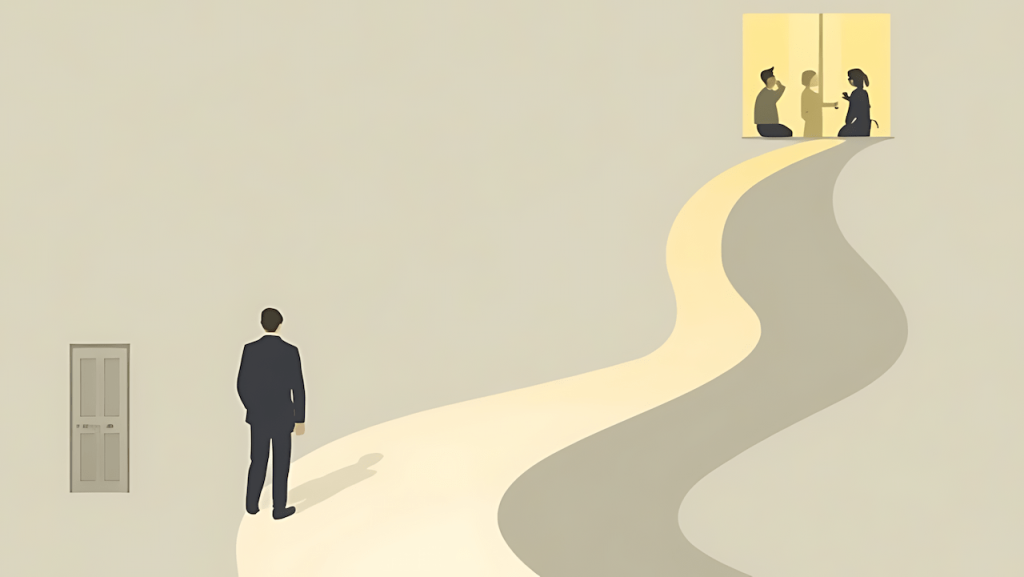
This Isn’t the Substance Abuse Story
Every recovery framework you will find online was built for a different onset story. Someone hands you a drink at a party. Someone offers you a pill to cope with real pain. There is a social doorway, a peer, an environment that opened the door. That is the model behind every 12 step program, every accountability app, every “identify your triggers” worksheet you will find if you search for help.
None of that applies here, and pretending it does is where most advice goes wrong before it even starts. Nobody handed you pornography. Nobody pressured you into a private moment alone with a screen. It was simply always available, the second curiosity or boredom or a bad day showed up. That is not a gateway. It is a standing offer that never closes, and the difference matters because it changes what actually has to change. You are not avoiding bad company. You are competing against a door that is open around the clock, and no accountability partner changes how open that door stays.
The Mechanism: Convenience Beats Connection
Your brain does not rank options by how much pleasure they deliver. It ranks them by return on effort, speed against certainty against cost. Fast, certain, and low cost wins against slow, risky, and high value almost every time those two options compete without anything correcting the scale. That is not a moral failing. That is exactly how a system built to conserve energy is supposed to work, and it works precisely the same way it works in every other system running your mental operating system, optimizing for whatever path costs the least right now.
The part nobody explains is what happens with repetition. The first few times, the shortcut is just the shortcut. Somewhere past that point, your brain stops merely tolerating the convenient option and starts preferring it outright. Pursuing a real person requires putting yourself somewhere you might be rejected, spending time you might not get paid back for, tolerating uncertainty from the first message to the last one. None of that is required by your hands or a toy. The gap between those two costs does not stay neutral forever. Repeat the cheap option enough times and the expensive one starts to feel like it is not even worth attempting. That is not you being lazy. That is the same small thing, held long enough, quietly becoming the large problem, one repetition at a time.
What It Actually Costs
Two things happen at once, and the piece that gets skipped in every other article on this topic is that the short term function here is real. Someone dealing with premature ejaculation or erectile difficulty may genuinely find release here that feels safer than the alternative. Someone under real stress may be using this exactly the way another person uses a drink after a brutal week, as a fast way to come down. Pretending none of that is happening does not make the piece more honest, it just makes it useless to the person actually reading it.
But the cost runs in a specific direction and it is worth naming plainly. Every rep spent on the convenient path is a rep not spent building the skill of actually pursuing someone, sitting with the discomfort of not knowing if it will work, and staying in a real relationship long enough to get good at one. Left unaddressed long enough, the frame does not stop at behavior. It starts shaping how you see the person you would otherwise be pursuing, shifting from someone to actually know into a source of a fast, certain outcome. That shift rarely announces itself. It shows up later as noticing you have started evaluating people by how quickly they might deliver something, rather than as people at all.
Why Just Stop Fails
Willpower alone loses here because you are not fighting a bad habit, you are fighting a system that currently wins on every axis it is optimizing for. Speed, certainty, cost, and control all favor the shortcut, and telling yourself to simply stop does not change any of those four numbers. That is why blockers and accountability tools work as one link in the chain and fail as a complete fix on their own. A blocker raises the cost of the convenient path. It does nothing to lower the cost of the real one, and if the real path still feels prohibitively expensive, you have only made the shortcut slightly more annoying, not actually less preferred.
The interrupt that works has to move both numbers, not one. Raise the friction on the convenient path, yes, remove the device, remove the privacy, remove the automatic access. But also lower the friction on the real path, deliberately and on purpose. That might mean setting a standing rule to message one person a week regardless of whether you feel ready. It might mean treating the discomfort of possible rejection as the actual cost of the thing you say you want, rather than as a reason to retreat to the option that has none. This is the same principle behind recovering from burnout without the option to fully step back, you do not wait for conditions to become easy, you change what the easy option is allowed to cost you.
The Reframe
You were never broken for choosing the path that cost less. That is what every system does when nothing corrects it. The actual work is not building more willpower to fight a system that is winning on every metric it tracks. It is changing which axis you are optimizing for in the first place, on purpose, before the next moment of boredom or curiosity makes the choice for you again. Beating pornography was never about being strong enough to say no. It is about noticing you have been optimizing for the wrong thing, and deciding, deliberately, to optimize for something else instead.