
Most habit advice tells you to find more motivation. That’s backwards, and I only understood why while mopping my own kitchen floor thirty five years after I first got paid to do it.
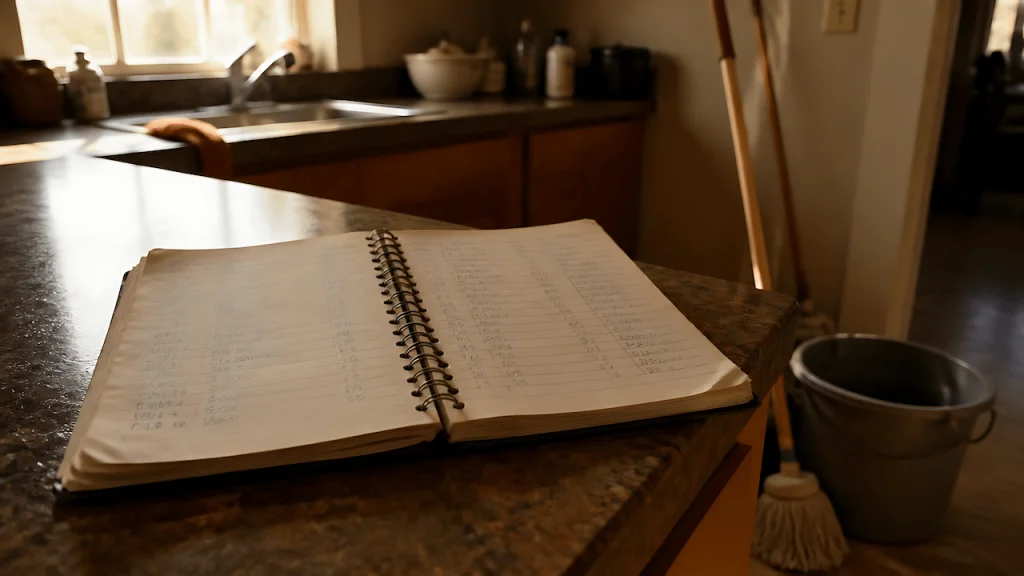
I grew up in the Philippines, and in 1988 my daily allowance was 5 pesos. My mom started paying me 1 peso per chore on top of that: sweeping, then mopping. A peso was real money to an 8 year old back then, and getting one on top of my regular allowance felt like a windfall. She wrote every payment down in a notebook, next to what task it was for. As I got older, the list grew. Washing dishes got added, then cooking rice, then by high school actual simple meals. The rate went up too, from 1 peso to 2, eventually to 5, depending on the year and what I was doing. None of this felt like a system at the time. It just felt like how things worked in our house.
Why “just be more disciplined” doesn’t hold up
Most content about building habits leans on willpower. Find your motivation. Visualize the outcome. Push through resistance. None of that explains why a task you dreaded at 8 becomes something you do without thinking at 38. Willpower is a resource you run out of. It cannot be the mechanism behind a habit that has survived three decades, because nobody has that much willpower for chores. Something else has to be doing the work, and it’s not inspiration. It’s structure.
How to build a habit: the 3 stages I actually lived through
Looking back, what my parents built without ever naming it was a 3 stage system, and it maps to how habits actually get built, not how self-help content usually explains it.
Stage 1: Command.
At 8 years old I had no say in it. I swept and mopped because I was told to. There was no negotiation and no appeal to my internal motivation, because an 8 year old doesn’t have a reliable internal motivation to appeal to. This stage exists to get the behavior happening at all, before any belief about it forms. Most people trying to build an adult habit skip this stage entirely and expect motivation to show up first. It doesn’t. The behavior has to start before the feeling does.
Stage 2: Incentive.
This is the part most habit advice ignores completely, and it’s the part that actually did the heavy lifting. The peso per task wasn’t a bribe. It was a bridge between doing something because you were told to and doing it because it produced a result you cared about. As the tasks got harder, the incentive scaled with them, from 1 peso to 2 to 5 pesos across the years, and the list of chores grew from sweeping to full meal prep by the time I was in high school. My mom’s notebook mattered here too. Every payment was logged against the task it was for, which meant the exchange was never vague. I could see exactly what I’d earned and exactly why. That’s the accounting habit I still carry, the instinct to track what you put in against what came out. If you’re building a habit now and skipping straight from command to hoping it sticks, you’re missing the stage that actually bridges the gap. This is the same gap micro wins close for adults trying to build momentum on something new.
Stage 3: Internalization.
At some point, probably somewhere in high school, the money stopped being the reason. Cooking rice or washing dishes wasn’t a paid task anymore. It was just something I did, the same way I’d brush my teeth. The habit had moved from an external transaction to an internal default. Nobody flips this switch on purpose. It happens after stage 2 has run long enough that the behavior and the identity merge. This is also where most adult habit attempts fail, because people expect stage 3 to be the starting point instead of the destination.
What actually transferred
The chores themselves didn’t matter long term. What stuck were the five things underneath them. Hard work, because the work had to actually get done for the incentive to count. Responsibility, because the tasks were mine and nobody else’s. Frugality, because I was tracking pesos earned against pesos spent from a young age. Accounting, straight from watching that notebook fill up week after week. And accountability paired with integrity, because the ledger meant there was no room to claim I’d done something I hadn’t. None of that came from a lecture about values. It came from a structure that made those values the only way the system worked.
This article has Amazon links. The obvious kind that connect to what we just talked about, not random products we pretend fit the system.
Buy through them = small commission for MomentumPath. Your price stays the same. Zero paid placements. Zero products picked because they sound impressive.
☕ Or just support directly and cut out the middleman.
The tools that keep stage 3 from breaking
Stage 3 is fragile in one specific way. It runs on autopilot right up until something makes the task harder than usual, a busy week, a bad back, a floor that somehow needs cleaning twice as often as it used to. That’s usually where an automatic habit quietly reverts to something you have to think about again. The fix isn’t more willpower reserves for the hard weeks. It’s removing enough friction that the hard weeks don’t matter.
There isn’t one tool that does this. There’s a lever for whichever part of the task is actually your failure point, and picking the wrong lever is why a lot of “get a gadget, fix your habit” advice doesn’t work. If the task itself is what you resist, you want a full automation lever, something that takes the chore off your plate entirely. If you don’t mind doing it yourself but you resist how long it takes, you want a friction reduction lever, a tool that makes the manual version faster instead of removing it. If neither of those is the real problem and it’s actually the setup and putaway that gets skipped, you want a maintenance lever that shrinks that overhead specifically.
If you’re only fixing one friction point, fix the one that’s actually breaking your routine, not the one that looks most impressive. A Robot Vacuum handles full automation for anyone whose actual resistance is doing the task at all, not how well it gets done.
| Lever | Best for | Why it works |
|---|---|---|
| Robot Vacuum | You resist the task itself, not the outcome | Removes the task from your day entirely, runs on a schedule, doesn’t need you to remember it |
| Cordless Stick Vacuum | You don’t mind doing it, you resist the time it takes | Cuts a full vacuum session down to a few minutes, no cord, no dragging a canister room to room |
| Cleaning Caddy Organizer | The cleaning isn’t the problem, the setup and putaway is | Keeps everything staged and accessible so starting the task has zero prep step |
Full automation. This is the closest thing to what happened to me by stage 3, the task stops requiring a decision. A robot vacuum on a fixed schedule means the floor gets swept whether you thought about it that day or not, which is the entire mechanism behind stage 1 turning into stage 3 in the first place. You’re not building willpower to remember it. You’re removing the moment where willpower would’ve been required.
Friction reduction. This lever is for the person who doesn’t actually mind cleaning, they just let it slide because a full vacuum session eats 30 to 45 minutes they don’t reliably have. A lightweight cordless stick vacuum, the tier a Dyson sits in, turns that into a 5 minute pass you can do without changing your schedule around it. The habit doesn’t need to be automated away here, it just needs to stop being expensive.
Maintenance lever. The most overlooked failure point isn’t the cleaning itself, it’s the ten seconds of finding where the supplies are before you can even start. A simple caddy or cart that keeps everything staged near where you use it removes the setup cost that quietly kills a habit before it begins. This is the same principle as my mom’s notebook, low friction to start, no ambiguity about what happens next.
None of these tools build the habit for you. They do what the incentive did at stage 2, they lower the cost of doing the thing until doing it stops requiring a decision. Pick whichever lever matches your actual resistance point, not the one that sounds most impressive in a product review.
Applying the same structure to a habit you’re building now
You can build this same 3 stage arc into anything you’re trying to make stick. Start with command: pick the behavior and do it on a fixed schedule regardless of how you feel about it that day, the same way I had no vote on sweeping at 8. Add an incentive that’s tied directly to completion, something you can log and see accumulate, not a vague reward you might get around to. This is where a system like the one behind how to build momentum actually plugs in, because momentum is what stage 2 produces once the incentive keeps the behavior running long enough. Then get out of the way. Internalization isn’t something you force. It’s what happens after stages 1 and 2 have run long enough that stopping feels wrong. If you want the full picture of why relying on motivation alone was never going to get you there, the underlying mental operating system behind this is the same one that shows up everywhere else you’re trying to change a behavior, not just chores.
The part people get backwards
The failure in most habit advice isn’t a lack of information. It’s the assumption that motivation comes first and the routine follows. My parents never waited for me to feel motivated to mop a floor. They built a structure where the behavior happened regardless, then let the incentive and repetition do what motivation never could. That’s the same argument behind why relying on excuses instead of structure keeps people stuck, and it’s the same reason understanding what actually drives you matters more than trying to manufacture more of it. If you’re serious about tracking a habit the way my mom tracked that notebook, a physical planner or tracking system does the same job her ledger did, just built for you instead of an 8 year old.
Motivation was never the missing piece. Structure was. I just didn’t understand that until I was scrubbing my own floor and realized I’d been running the system my parents built for me since 1988, minus the peso.