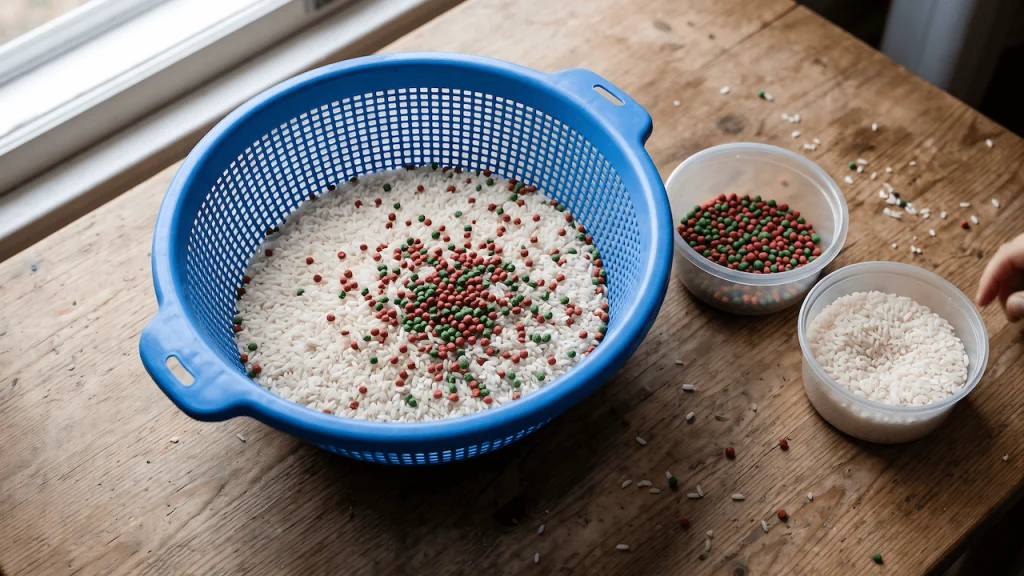
My daughter mixed about 350 grams of fish pellets into 10 kilos of our rice this morning, and the way I ended up sorting it is the best problem solving method I’ve used in a long time. She has ASD (autism spectrum disorder), so this wasn’t mischief with a lesson attached. It’s a problem I didn’t cause and can’t fix by force, and that’s the exact shape of most problems in life.
The rice is just where it started. What I found while sorting is that how you pull a mixed pile apart decides whether you burn out halfway or can walk away and come back to finish it. That holds for a bowl of rice, a backlog of bugs, a site with six things wrong at once, or anything where the bad stuff is mixed in with the good.
Why Punishing Her Gets Me Nothing
I got angry first. That’s the most human thing there is. It’s 10 kilos of the family’s food, and I opened the container to red and green pellets all through it. The anger isn’t something I’m proud of or ashamed of, it’s just what happened.
What comes next is where my daughter changes the usual script. With another kid, you make her pick it all up, you tell her never to do that again, maybe there’s a spanking, and the connection gets made. With her, nothing gets made. If I punish her, or make her clean it up as a penalty, all she learns is that this was a punishment, and she’ll do it again, because the way she learns doesn’t tie the pellets, the rice and the consequence together. My eldest never did anything like this, so I never had to think about it with her.
I still tell her it’s wrong. I can have her help with the sorting, but she won’t take it the way another kid would, so I have to be extra careful how I do it. Which leaves me one tool, patience, and patience runs out unless there’s a system behind it. I wrote about what that costs in living with autism triggers. The problem didn’t come from me, but what I do with it is the part I control.
Throw It Out or Sort It
Two or three stray grains of rice, I’d toss without thinking. Ten kilos is different. That’s food for the whole family, and throwing all of it out to skip the hassle is a decision that shows up weeks later, when there’s no emergency fund and you’re buying rice you already had. I’m thinking about the next few months too, not only today.
So it was never really a choice between throwing it out and sorting it. Dumping the whole batch over a few hundred grams of pellets costs more than the sorting does. The only open question was how to sort it without losing my sanity doing it.
The Quiet That Made It Possible
My youngest was already at school when I started, and that helped more than I expected. I dropped her off, came back, and sat down with the rice in a quiet house. No music, no TV, nothing competing for my attention. Just my hands and the pile.
That matters for the method. This kind of sorting runs on small repeated movements, and you can’t hold a pile of problems in your head while other noise is also in it. I was angry when I opened the container. Somewhere in the quiet, with my hands busy and my head free, I wasn’t anymore.
Attempt 1: The Colander
My first move was the obvious one. Pour the rice into a colander, shake, and let the pellets fall through. Some did. The trouble is the pellets are about the size of the rice, so a lot of them pass through with the grains and some stay behind. It works, it just isn’t optimized. A proper sieve with the right hole size would do better, but then I’m paying for a tool to do one job.
What I noticed is how much the shake changes the result. Fast, slow, side to side, up and down, each one puts the pellets somewhere different. Shake fast and more pellets disappear into the pile, but I didn’t want them hidden, I wanted them gone. Look at what falls through underneath and it’s a mix of rice and pellets anyway. I slowed down, and the side to side motion surfaced the pellets so I could scoop clean rice from the middle, but the pile was still there with pellets still mixed in.
That’s what shaking a whole problem does. It moves the problem around, which feels like progress, and the volume stays exactly the same.
Attempt 2: Clean Rice Out, Pellets Back In
Next I picked clean rice out by hand into a clean container and put any pellets I caught back in the colander. The clean batch grew and the rice pile shrank, so on paper that’s progress. But every time I looked at the colander I saw the same problem, because the pellets never left. The rice kept moving out and the pellets stayed in front of me, getting denser.
It would have worked eventually. It takes long enough that the pile of problems wears you down before you finish, and that’s what burnout is in this method. You’re making real progress and you can’t see it.
Attempt 3: Only Taking the Pellets Out
Then I tried the opposite. Leave the rice where it is and pull pellets out of the colander into a separate container. That’s faster, and it feels productive. I’d clear the top, cycle through the pile, and another set of pellets would show up. Same volume, no visible win, and every pass felt like starting over. Mentally it was harder than the slower ways, even though it was quicker in minutes.
When you only remove the problem and never move anything into a finished state, you have nothing to show for it. The pile looks the same at minute 30 as it did at minute 1.
Attempt 4: Two Containers
What finally worked is what I use now. I take a handful, pick the pellets out into one container, and move the clean rice into a second, clean container. Pellets in one, clean rice in the other, and the colander gets emptier as the clean container fills.
Now I can see both sides. The pile of problems shrinks and the clean pile grows, so progress isn’t an idea in my head, it’s a container of rice I can cook later. When a pellet gets stuck between my fingers and lands in the clean rice, it stands out right away, because there are only two or three of them against a clean pile. In the big mixed pile I’d never have spotted them.
That’s also how small wins compound. When the clean container is full I move it to its permanent container, and watching that fill is what keeps me going while the colander still looks like a mess. I wrote about why micro wins work when motivation fails, and this is that mechanic with a bowl of rice. You don’t need the whole thing to look finished, you need to see the finished part getting bigger. It’s the same loop behind how to build momentum.
What Each Problem Solving Technique Costs
Every problem solving technique has a cost, and the cost decides how you feel when you’re done.
- The colander is fast and cheap, but the problem comes back, because leftovers stay mixed in and spoil whatever you do next.
- Picking clean rice out while the pellets stay in the pile costs no money, but it costs you the feeling of progress, and that’s what burns you out.
- A better sieve or hired help costs money and still leaks, because the pellets are close to the size of the rice.
- Two containers cost time. They still take a while, but they remove the cost that hurts, which is burnout.
None of them is free. When I can do the job myself and the only thing at stake is time, I’d rather pay in time than in money. That won’t be the right call every time, but it was for one bowl of rice.
Where Automation and AI Fit In
While I was sorting, I started thinking about how I’d do this with code, and it’s less different than I expected. In code, sorting is a rule that splits a list in two. Take each item, run it through a test (is this a pellet or a grain), and send it to one list or the other. That’s the two containers again. Rice mills do the same with cameras that spot the wrong color and push it out with a jet of air.
What code doesn’t need is the small wins. A script doesn’t get tired of looking at the pile. The person running it does, and that’s why progress bars and counters exist. On a big database or years of data, the counter isn’t there for the program, it’s there so the human can see something moving and trust it enough to leave. AI works the same way with one more cost, because someone has to prompt it and then judge what comes back. I wrote about what that did to my own judgment in cognitive offloading, and the lesson holds here. Automation takes the sorting off my hands, but it doesn’t take away my need to see that it’s working.
The Same Problem Solving Method on Any Pile
The rice was just the way in. The method is the same whenever two kinds of things are mixed together: pull the problem out into its own container, move the clean stuff to a separate one, and watch both.
In code it’s clean code and bugs. In QA it’s passing tests and failing ones. On a website it’s the pages that work and the ones that don’t, or the six things I keep shaking around at once: monetization, traffic, impressions, keyword targeting, the theme. Every time I work on one, another one surfaces, because I’m shaking the colander. The version that works is picking one, moving it to a finished container, and watching the clean one grow. That’s how I handle one problem at a time, and it’s how I deal with problems in life when they all arrive at once.
A lot of advice on how to solve a problem stops at breaking it into smaller parts. That’s step one. What the rice showed me is the part that gets left out: the small parts need somewhere to go, so you can see the finished ones pile up.
Where I Am Right Now
I’m still sorting. About a quarter of the rice is done and I already have clean rice I can cook later. I stopped to write this down while it was fresh, and the reason I can stop is the part I care about most: it’s no longer a big deal. I’m not angry or stressed, I’m just tired of looking at it. I can step away because I know what I’ll do when I get back, and at this pace it’s 30 minutes to an hour to finish.
That’s what a working system gives you. It doesn’t make the pile smaller, it makes the pile stop being a threat. It’s the closest thing I’ve found to how to stop feeling overwhelmed when a problem is bigger than the time you have for it, and it’s the same reason a start condition matters, because knowing how a job starts and what done looks like makes walking away cost nothing.
The rice isn’t done and the pellets are still in the bowl. The difference is that I know what happens next, and that’s enough to put it down for an hour.