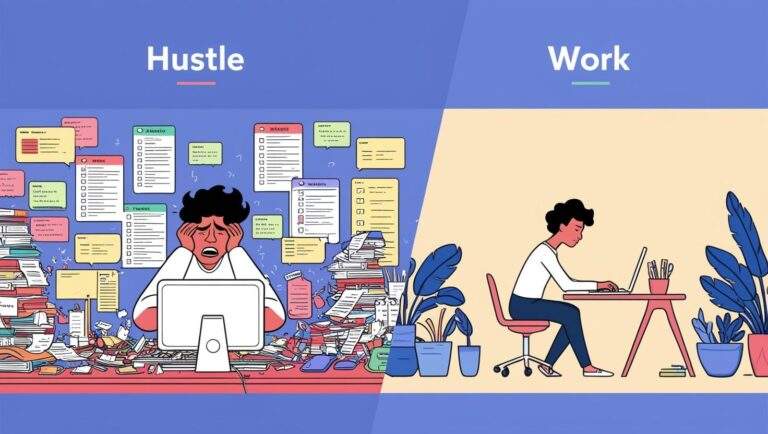
I built a workflow where every input is automated except one, the signal that starts it. The plan is written down, the topics are lined up, the research and drafting steps run with less context from me every time, and I still sit there not starting. Most advice on how to stop procrastinating treats that as a motivation problem, and it isn’t. It is a missing start condition.
Every Input Automated Except the Start
I have 6 to 8 hours a day set aside for my sites. The workflow has a research step, a drafting step, everything written out, and I optimized it until it needed less context from me than it did the first time I ran it. When I say go, it runs. That part works.
What doesn’t work is the go. Whenever I open the computer and begin, I tend to say I’ll do it later, when I’m ready, and then the day ends and I haven’t done anything. It has been a couple of days of this. I planned to start last week, then this week, and I still haven’t started my newest workflow properly, I’m only doing it slightly.
This isn’t avoidance. When I start working, I continue until it’s done, that’s how I’ve always been. Procrastination here is a startup failure, not a runtime failure, which means the runtime is fine and the startup is the bug.
Overload Was Part of the System
The old problem was that people had too much to do. The house, the kids, the family, and then the report you had to do manually and the form you had to fill up by hand, because that’s what working required. That work overload did two jobs inside the system. It was the pressure that forced the start, and it was the excuse for any delay.
I wrote about how that kind of outside push works in my post on how to build a habit that sticks, where my mother paid me per chore and logged every payment. The motivation moved from a command to an incentive to something I did without thinking. The start came from outside until it stopped needing to.
Take the overload away and the process loses its start condition, because your motivation to work was never carrying the first step by itself. Nobody is asking why do I procrastinate so much when a deadline is doing the starting for them. The question only shows up when the push is gone and the first step is all that’s left.
What AI Took Out of the Load
With AI productivity tools and an AI workflow, a lot of that manual load is gone. That sounds like pure upside until you notice the load was also doing a job. AI took the grind and the pressure together.
AI only helps if you can judge what comes back. I’m a QA, I’ve been a PM, I can code, and I still vibe code, because I understand what I’m looking at. If you vibe code with no plan and you can’t debug, the first thing that breaks leaves you stuck. I’ve already written about what cognitive offloading cost me, and the cost was judgment, not just time.
There is a second thing AI can’t take. It can run the workflow once I say go, but I still have to give it my own time and situational awareness for it to finish. As a solo operator that is another problem, because nobody else is going to say go.
How to Stop Procrastinating When the Start Condition Is Missing
I’m the worker, the operator and the boss, so I’m overlapping everything. Every deferral is a management call, I have the authority to say let’s pause this first and do something else. At a job somebody else’s deadline overrules not now, and here the only person who can overrule it is the one asking for it. In systems terms, nothing in the loop penalizes a deferral.
Taking the starting decision away isn’t the fix either. It feels like something is getting forced again, and a forced start is just a boss with my own name on it. I don’t want a rigid 9 AM start. I want to start when I start, which is exactly why the condition has to be something I choose.
The workflow also made the choice harder in a different way. Because it needs less context from me, I’m not locked into one whole process anymore, so I can run several things. That is where analysis paralysis and decision fatigue come in, picking what goes first every morning with the whole plan open in front of me. This is a task initiation problem, the gap between not working and working, and the work getting cheaper did nothing for it.
Why Ready Is Not a State the System Can Reach
I never get ready. I’m free to start whenever I’m ready, so the condition I set is one that never becomes true. The wind up before starting anything is the loop with no exit, and the day ends inside it.
Everything in my day that does trigger points somewhere else. I wake up at 5 AM, we leave around 5:45 for my eldest’s school, I’m back by 6 or 6:15, then I take my youngest at 7:45 and pick her up at 11, and I leave around 2:55 for my eldest. Those triggers work because somebody is waiting and being late costs something. None of them point at the desk.
The computer isn’t a trigger either, because I either never turn it off or I turn it on the second I leave the bedroom, then make coffee. That’s a reflex, so it marks nothing. After the last drop off it’s coffee on the terrace, then AdSense, Amazon, Facebook, LinkedIn for QA topics, the news, sometimes TV, all to prep my mind so I think, hey, I want to write something about this.
That is the part I trust least. Starting from Reddit or LinkedIn is a cop out for work, because you’re gambling for attention. If something doesn’t catch me, I keep scrolling, and something can catch me that I’d never write, like a Division 2 post where I think, hey, I gotta fucking try that out, when that’s a cheap, saturated build guide that wouldn’t win the site any long term traffic.
It has worked once. I was browsing Reddit, thought oh, this is a good topic for a post, and I started. Nobody said go, it happened sideways, and you can’t build a system on a start that depends on luck.
Writing a Start Condition That Isn’t a Rule
A start condition is an act with a clear before and after, not a rule. That is why a VA’s software clock in works, and why some people get used to clocking in and others take a bath and get dressed, it depends on your preference. These are ideas to test, and none of them is proven.
- Write a start line: a notebook or log with the date, the time and the first task, which is a clock in you build yourself.
- Attach the start to the last obligation: the drop off ends, you walk in, and the first act is opening the task you already chose.
- Put one line in the work doc before the feed: browsing comes after, as input, not as the start.
- Make the first act too small to need readiness: write the title or the first sentence.
- Choose tomorrow’s first task tonight: leave yourself a note you can swap, and write it yourself so it isn’t a forced start.
Most of these are habit stacking, where you pin the start to something you already do, and a morning routine for productivity works the same way if it ends in a specific act and not a vague feeling of being ready. A fake commute does the same job for people whose day has no commute, and the full list for flexible and solo remote workers is in the RemoteWorkHaven version of this post. A missing trigger is also one more way a system fails, which I covered in why productivity systems fail.
What the Research Backs Up
Peter Gollwitzer’s paper on implementation intentions describes an if-then plan that pairs a situation you expect to meet with a specific action you’ll take when it shows up, which is different from a goal intention that only commits you to an outcome. According to the abstract, these plans help people who struggle to turn intentions into action, including failing to get started, getting distracted and slipping into bad habits. The if part is the start condition and the then part is the first action.
On habits, the Lally et al. study had each participant tie a chosen behavior to a daily cue. Habits took an average of 66 days to reach peak automaticity, with a spread from 18 days to a projected 254. Missing a single day had little effect, though many missed repetitions gradually lowered the level people eventually reached. The researchers couldn’t draw clear conclusions about how consistent the cue itself needs to be.
Where the System Stands
My start condition is a sequence, not a clock time. The last drop off ends, I have my coffee, and then work starts, with browsing and research counted as work. That fixes what bothered me about the feed, because a quiet feed doesn’t stall the day anymore, since the browsing is already the first task.
I haven’t fixed it. The feed has no built in end, so the first task has no stop condition, and I don’t yet have a signal that tells me the research phase is over. I’m testing it and I’ll find out whether it holds. A system that can’t start isn’t broken, it’s missing one input. If you can start now and the next problem is that your motivation keeps fading, read how to build a habit that sticks.