
You can’t finish a one year task in one day, and nobody tells you how to break it down so you can leave it and come back without losing your place. That is the part of cognitive load theory that stuck with me. It’s about spreading work out so the state it was left in is easy to recall when you return.
The stress rarely lives in the work itself. It shows up in the coming back, when you have to rebuild where you were and what state everything was left in. I treat that as a systems problem, the same way I treat most things on this site, which is the mental operating system view and not a discipline one.
Cognitive Load Meaning in Plain Terms
Cognitive load is the effort your working memory is using at any given moment, and working memory is limited. Cognitive burden is a fair way to describe how that feels, the weight of everything you’re holding at once. It is not a bad thing by default. You need cognitive load to work or learn at all, and the real question is how much of it is the useful kind.
That framing matters because most of the advice around this topic treats load as something to get rid of. Cognitive load theory doesn’t say that. It says the load has to fit, and that what you do with the task, how you cut it up and when you come back to it, decides whether it fits.
Intrinsic, Extraneous and Germane Load
Cognitive load theory intrinsic extraneous germane is the standard split, and each one answers a different question about the work. Intrinsic cognitive load is the task itself, how many pieces have to be held together at once. Extraneous load is effort spent on how the work or the information is laid out, which adds weight without adding anything useful. Germane cognitive load is the effort that builds understanding, so it’s the one you want room for.
These are the types of cognitive load I keep in my head when a task feels heavy. I ask which kind is heavy. If it’s the layout, I fix the layout. If it’s the task, I cut the task into pieces.
Breaking Work Down Is How You Manage Intrinsic Load
You can’t remove intrinsic load, because the task is the task. What you can do is pace it and cut it into pieces that fit in your head, and that is the part of the theory I rely on most. A one year task doesn’t fit in one day, so it gets broken into pieces and each piece gets done in a sitting.
That doesn’t mean scattering the work across the next room or leaving everything unfinished. Each piece still gets finished. The break between pieces is where you leave the work and come back to it, and the whole point of the break is that coming back isn’t stressful.
Keeping the State Out of Your Head
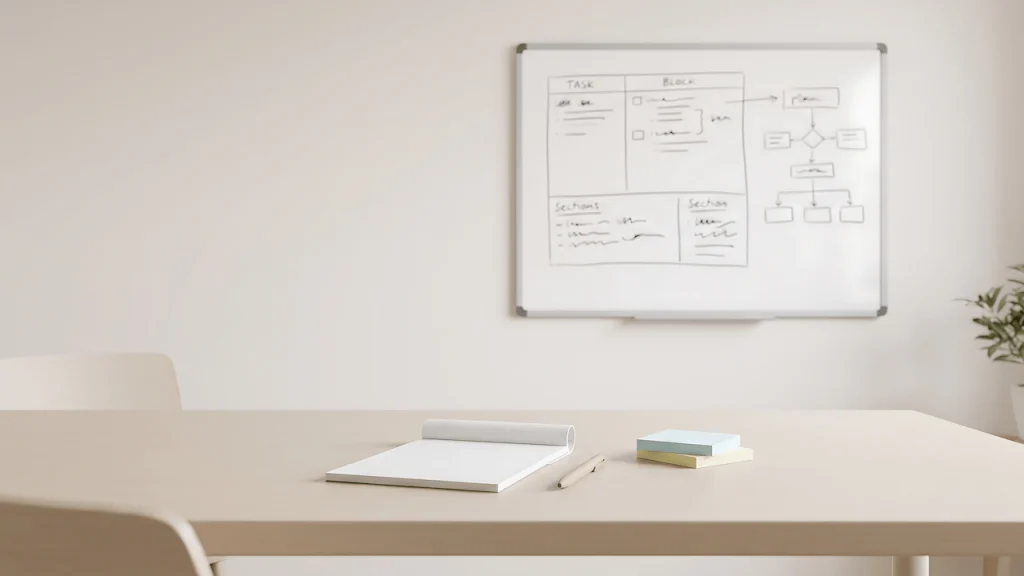
This is the old school part. I jot down the key info on my notepad or a post it, or I write it on my whiteboard. Only the key info, not everything. When I come back to the work, the state it was in is sitting there, and I’m not spending the first stretch of the session trying to recall it.
Context switching is what makes coming back expensive, because every switch forces a rebuild of where you were. I broke that down in context switching kills momentum. Writing the key info down is how I make that rebuild smaller, so the state of the work doesn’t live only in my head.
The Pause Is Where Germane Load Happens
I take information in short bursts, then give my mind time to process. The processing is germane cognitive load, the effort that builds understanding, so the pause is working time and not wasted time. Cutting the pause to squeeze in more information just fills working memory again with nothing left over for understanding.
This is also why a short burst beats a long dump of data. A short burst fits, I process it, and the next one starts from something I understand. A long dump doesn’t fit, and I end up holding it instead of using it.
Letting Something Else Filter What Comes In
Right now I also use AI to digest information so the useless and unrelated parts get dropped before they reach me. That keeps the burst I take in down to what the task actually needs, which leaves more room for the processing that follows. I still decide what the work is and when a piece is done, and I wrote about where that line sits in cognitive offloading and AI dependency.
What Coming Back Should Feel Like
The test for any way of breaking work down is the return. If I can sit down, read the key info I left, and be working again without stress about what state everything is in, the pieces were cut right. If I have to dig through my head to find where I was, the cut was wrong and the load is landing on me again at the worst moment.
That is why I judge the break by the return and not by how neat the plan looks. A one year task only gets finished if every sitting ends in a place I can walk away from and walk back to. Nothing gets left unfinished, and nothing gets crammed into a day it doesn’t fit in.
What to Ignore
Ignore advice that treats cognitive load as something to eliminate. Ignore the version of breaking work down where everything gets scattered or left half finished, because that’s just a different kind of mess. And ignore anyone who says one long session can cover a year of work.
The Textbook Version
John Sweller developed cognitive load theory in the late 1980s while studying problem solving. It started as a theory of learning and instruction, so using it for work and mindset like this is my own application of it, not something the theory claims. The standard pieces I lean on are the three loads, the limit on working memory and breaking material into smaller segments so each one fits.
Cut the work into pieces you can leave and return to. Write down the key info before you walk away. If you’ve done that and the hard part is starting the next piece, read how to stop procrastinating with a start condition.