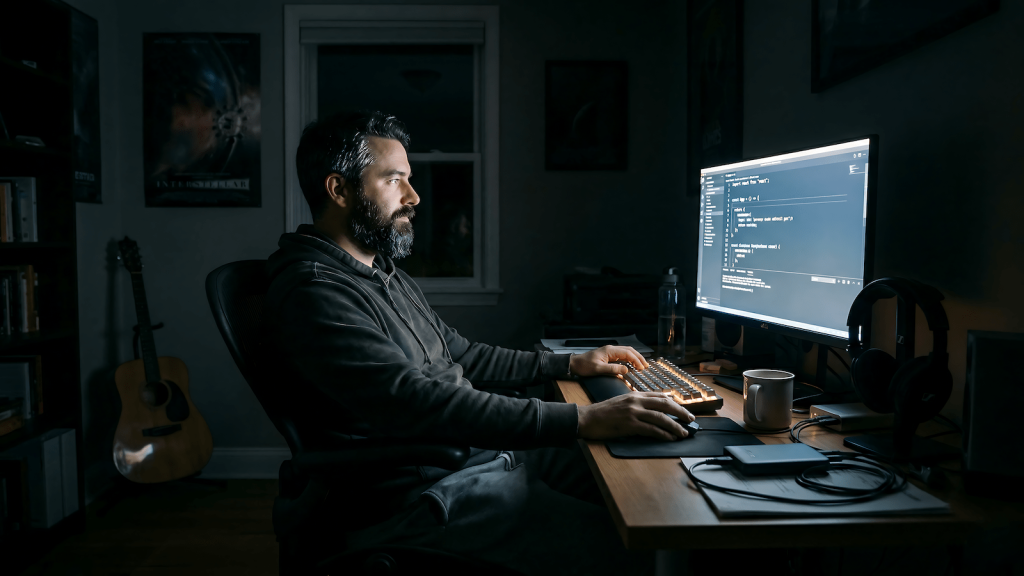
There is a phenomenon that every man in a household will recognize immediately. You can sit at your computer for four hours watching YouTube, browsing forums, staring at nothing in particular, and the house stays quiet. Nobody needs you. Nothing happens. Then the moment you open a code editor, load a game, or start writing something you actually care about, suddenly there are questions. Requests. Errands. It is almost supernatural, and it is almost always the reason why men need alone time at night.
This is not a complaint about families. It is not a verdict on partners or kids. It is an observation about how cognitive availability works, and why the only window many men have for genuine mental recovery is the one that starts after everyone else is asleep.
Why Men Need Alone Time at Night: The Brain Does Not Reset on Command
The standard advice is to decompress after work. Take a walk. Do something you enjoy. The problem is that decompression requires an environment that is not actively making demands. For men running households, managing careers, handling finances, parenting, and carrying the invisible weight of being the one who is supposed to hold everything together, the waking hours of the day rarely offer that environment. There is always something. A question only you can answer. A decision that needs a human. A request that is small but still pulls you out of whatever state you were trying to reach.
The brain does not reset on command. It needs continuity. It needs a stretch of time where the next interruption is not coming in three minutes. That is not a luxury. It is how cognitive recovery actually works, and it is the same mechanism that makes context switching so destructive to momentum. The cost is not the interruption itself. The cost is the rebuild every single time.
The Visibility Problem
Here is the specific frustration that rarely gets named clearly. It is not that your family interrupts you constantly. It is that they interrupt you precisely when you finally lock in. The random browsing, the idle scrolling, the staring at a screen while your brain drifts: none of that draws fire. The moment your posture changes, your attention sharpens, and you actually commit to doing something, that is the signal. Something shifts in the room. The energy changes. And the requests arrive.
You cannot fix this with headphones. You cannot fix it by closing a door. Because the trigger is not the sound of you working. It is the fact that you are now clearly in something, and that visibility is the invitation. The only environment that removes that trigger entirely is the one where the other people in your house are asleep and cannot read the room.
That is why men stay up until 2am. Not because they hate their families. Because 2am is the only time the house is not watching.
The Ick That Isn’t
There is a version of modern thinking that treats a man with a hobby as a red flag. Gaming specifically gets the worst of it. The word that gets used is childish. A grown man playing video games instead of being productive, being present, being useful, being whatever the current standard requires. The ick is real and it gets said out loud.
What nobody stops to examine is what gaming actually is for the man doing it. It is not immaturity in digital form. It is one of the few spaces where the outcome is fair. Where the rules are consistent. Where effort produces results and the wins are real, even if they only exist on a screen. The man sitting in front of that monitor is not escaping responsibility. He is entering the only world he operates in where he is not someone’s resource. Research backs this up too. A large-scale survey found that 89% of gamers identify video games as a stress reliever, and physiological markers like heart rate and cortisol levels measurably drop after a gaming session. The body is not lying even when the culture dismisses it.
That distinction matters. At work he performs for an employer. At home he provides for a family. He manages, absorbs, adjusts, and stays functional under conditions that are not always kind to him. Gaming is where none of that applies. He is not a provider in that world. He is just a person trying to win something, and that is a need that does not disappear because someone finds it inconvenient.
The deeper version of this is that modern expectations for men have a strange shape. Work hard, provide, be emotionally available, have goals, stay ambitious, but do not have hobbies that do not serve the household. Do not decompress in ways that look like leisure. Do not be unavailable, even for an hour, unless the reason is approved in advance. The Lord handed down ten commandments. A man’s household can generate that many before Tuesday.
That is not a criticism of any specific person. It is a pattern, and most men recognize it as a meme because the only way to carry something that heavy without cracking is to laugh at it. The joke lands because it is true. And underneath the joke is a man who is doing everything asked of him and still being told that the one hour he takes for himself is the problem.
Solitude After a Long Day Is Not Optional, It Is Structural
There is a version of this conversation that frames late night alone time as avoidance. As escapism. As a man checking out on his responsibilities. That framing misses what is actually happening. The man who games until 3am, who codes into the early morning, who writes posts or builds things in the silence after everyone else is gone, is not running away. He is running maintenance.
The research on solitude supports this framing directly. A study published in Scientific Reports found that solitude functions as an opportunity for autonomy need satisfaction, specifically the experience of being able to act in a way that is self-congruent and aligned with your own values. That is not a small thing for a man who spends most of his waking hours acting in ways aligned with everyone else’s needs. The late night window is not checked-out time. It is the only time the day belongs to him.
The alternative is not a man who is more present and engaged. The alternative is a man who is chronically depleted and increasingly short-tempered, because he never had the space to rebuild. Solitude is not the opposite of family involvement. It is what makes sustained family involvement possible. This is the same logic explored in where men actually put their pain when healthy outlets are unavailable. The pain does not disappear. It just moves somewhere less constructive.
Men who have no space for solitude after a long day do not become more connected partners and parents. They become quieter, more irritable, more checked out in ways that do not announce themselves as clearly as a guy sitting alone with a keyboard.
What This Actually Looks Like in a Functional Household
In a good household, this becomes a running joke rather than a source of friction. You talk about it. Your partner sees it. You both recognize the pattern, laugh at the absurdity of it, and the requests get fewer. The late nights become understood as your time, not as a problem to be solved or a behavior to be corrected.
That is the functional version. Not a household where the man never needs solitude, but one where the need is visible, named, and respected enough that it does not have to be stolen at 1am in secret. The conversation has to happen. The need has to be articulated. Because until it is named clearly, it just looks like a man who would rather stare at a monitor than be with his family, and that reading is wrong in a way that does damage over time.
Needing alone time when you have a family is not a character flaw. It is not immaturity. It is not a sign that something is broken between you and the people you live with. It is a maintenance requirement that adult men have and that nobody talks about honestly because it sounds too much like a complaint.
The Late Night Window Is Real Sovereignty
There is something that happens after the house goes quiet that is difficult to explain to someone who does not need it. The brain shifts. The ambient pressure of being available drops. You stop tracking the next likely interruption and start actually thinking. Projects that felt impossible at 4pm become tractable at midnight. Problems that were stuck become unstuck. The creative and technical work that requires you to hold large structures in working memory becomes accessible in a way it simply was not during the day.
This is why men need alone time at night specifically, and not just in theory at some undefined point in the schedule. The night is the only time the variables are controlled. No one is going to walk in. No one is going to need anything. The phone is quiet. The house is quiet. And the mind, finally allowed to operate without interruption, does what it has been trying to do all day.
That window is worth protecting. Not just for the work that gets done inside it, but for the person who emerges from it. A man who had his time is a different person the next morning than a man who never got it. He is steadier. More patient. More present in the hours that belong to other people. The late night alone time is not what takes him away from his family. It is what makes him available to them.
Me Time Is Not Selfishness. It Is How You Stay Whole.
The framing of me time as selfish is one of those invisible pressures that men absorb without examining. You are supposed to be present. You are supposed to be engaged. Every hour you are not actively contributing to the household is an hour you are somehow failing. That logic, followed to its conclusion, produces men who are physically present and mentally gone. Men who sit at the dinner table without being in the room. Men who nod along to conversations while their internal state is somewhere between exhaustion and quiet desperation.
The man who takes his late night window, who codes or games or writes or does whatever it is that makes him feel like himself rather than a function, is not checking out. He is checking in. With himself. With the version of him that exists outside of his roles and his responsibilities. That version needs maintenance too.
Understanding why men need alone time at night is not about granting permission. It is about recognizing what is already happening and naming it correctly. The late nights are not a problem. They are the solution. And in a household where that is understood, everyone wins.