Some gaps you can’t budget around.
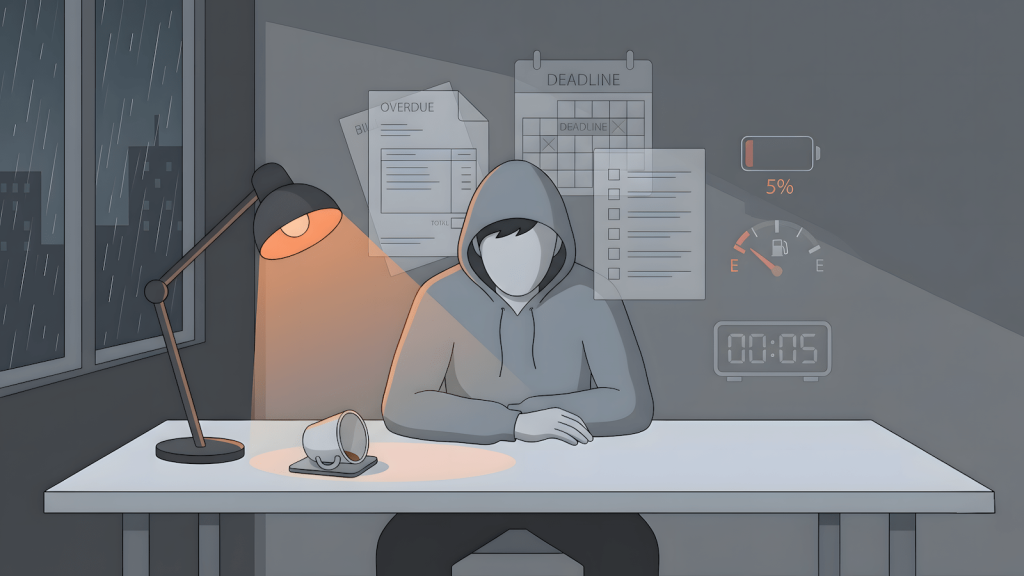
You’re working, but the money isn’t arriving on schedule. Or it’s arriving, but it’s not enough. The effort is constant, but the compensation is delayed, reduced, or tied to outcomes you can’t fully control. Meanwhile, every responsibility you had when things were stable? Still there. Still expecting you to show up with full capacity.
This isn’t about one hard thing. It’s about operating a system that’s running too hot, with too much friction, and no way to cool down.
When the Contract Stops Holding
People don’t slow down because they suddenly became lazy. They slow down because the foundational trade which is effort for reliable compensation had stopped working.
When pay becomes unreliable, everything else destabilizes. Not emotionally first, but structurally. Bills don’t pause because payroll did. Utilities don’t wait. Loans apply penalties regardless of your employer’s cash flow problems. A delay doesn’t affect one expense it forces tradeoffs across your entire month.
This is why delayed or unreliable pay is often worse than low pay. Low pay still allows planning. You can build a survivable structure around a known number. Unreliable pay destroys predictability. And when predictability goes, everything compounds.
You drain savings first. Then the emergency buffer disappears. Discretionary spending vanishes. Then you start making choices between essentials. Each delay doesn’t just create a financial gap it burns through your margin for absorbing any other friction in your life.
Related: I’ve written about this financial pressure creating impossible choices in The Hustle Dilemma: When You Need Money But Want Sustainable Success.
The Energy Problem (That Nobody Accounts For)
You’re tired in a way that sleep doesn’t fix. Not the “I stayed up late” tired the cumulative, compounding tired that comes from operating in deficit for too long.
When financial reliability disappears, your brain shifts into conservation mode. This isn’t a conscious choice. It’s mechanical. Decisions slow. Initiative fades. Risk disappears. Not because you stopped caring, but because your system is protecting itself.
The cruel part? Your responsibilities don’t recalibrate to match your reserves. The toddler still needs to be fed. The project still has a deadline. Your inbox still expects coherent responses. None of these adjust their expectations based on how depleted you are.
And when you’re already running on limited time, limited money, and rapidly evaporating patience, there’s nowhere to borrow from. No cushion. Every unexpected thing becomes a crisis because there’s no margin left.
Related: This cognitive depletion gets misdiagnosed constantly. I explored this in Why You Can’t Focus: It’s Not ADHD, It’s Burnout. The symptoms look the same, but the cause is different and so is what actually helps.
Limited Everything (And the Lies You Tell Yourself)
Limited time. Limited money. Limited patience. Limited energy.
When one resource runs low, you can usually compensate with another. Work more hours to make more money. Spend money to save time. Rest to rebuild patience. But when multiple resources hit their floor simultaneously, the entire system becomes brittle.
You start telling yourself stories: “I just need to push through this week.” “Once this payment clears, I’ll catch up on sleep.” “After this deadline, I’ll take a break.”
But the pattern doesn’t break. Because the pattern isn’t about this week, this payment, or this deadline. It’s about operating conditions that aren’t sustainable being treated as temporary when they’re actually structural.
The most damaging lie: that rest is something you earn after you’ve handled everything. Recharging isn’t a reward. It’s a requirement for the system to keep functioning. But when you’re running on empty, treating rest as optional becomes the default.
Related: When resources are this constrained, you need systems designed for scarcity, not abundance. That’s why I wrote Survivable Life Routine for building structure that holds when you’re at minimum capacity, not when everything’s going well.
Living in Permanent Limbo
Then add this: major things are unresolved.
Will the payment come through? Will they renew the contract? Will the test results come back okay? Will the client actually commit? Will the position open up? Will they approve the loan?
Real questions. Real consequences. Hanging in administrative or circumstantial limbo.
You can’t plan around them because you don’t know the answer. But you also can’t stop functioning while you wait. So you make decisions with incomplete information. You show up professionally while the ground feels unstable. You act normal while nothing feels resolved.
This creates a specific kind of exhaustion not from doing hard things, but from maintaining performance while fundamental uncertainties remain unaddressed. You’re operating as if conditions are stable when you know they could shift at any moment.
The worst part? Nobody sees this. From the outside, you look fine. You’re still showing up. Still meeting deadlines. Still responding to messages. What they don’t see is the constant background calculation: “If this falls through, then what? And if that doesn’t work, then what?”
Related: This kind of sustained pressure under uncertainty requires a different approach to resilience. I wrote about this in How to Perform Under Pressure: Building Mental Resilience.
How It All Compounds
This is where it becomes mechanical:
Working unpaid (or unreliably paid) → no financial buffer → stress when anything unexpected happens → drains energy faster → harder to resolve uncertainties → everything feels more fragile → patience runs out → small things feel impossible → performance drops → which gets labeled as a “you” problem instead of a systems problem.
When pay fails, everything else follows. Not because you became less capable, but because the foundational trade that allows everything else to function has broken down. High performers don’t quit immediately they disengage internally first. By the time visible attrition appears, the damage is already done.
This isn’t about motivation. It’s not about mindset. It’s about a system being asked to perform under conditions it wasn’t designed for, with none of the resources required to maintain output.
What Actually Helps (When Standard Advice Doesn’t)
Standard productivity advice assumes baseline stability. It assumes you have margin. It assumes the problem is optimization, not survival.
When you’re running on empty, optimization isn’t the issue. The issue is that you’re being asked to operate as if conditions are normal when they decidedly are not.
What actually helps:
Acknowledge the actual conditions. You’re not failing at normal life. You’re succeeding at extremely difficult life while pretending it’s normal. Stop measuring yourself against standards that assume resources you don’t currently have.
Design for minimum capacity, not peak performance. Your systems need to hold when you’re at 30% energy, not just when you’re fresh. This means brutal simplification. This means automation where possible. This means letting non-critical things fail. (Survivable Life Routine goes deeper on this.)
Recognize conservation mode as protective, not broken. When your brain pulls back initiative, slows decisions, and eliminates risk-taking, it’s not sabotaging you. It’s keeping the system from catastrophic failure. Work with it, not against it.
Stop treating rest as earned. Recharging isn’t a reward for completing your task list. It’s the thing that allows the task list to be possible at all. When you’re operating depleted, rest isn’t optional it’s structural maintenance.
Find the smallest wins that actually register. Big victories require resources you don’t have right now. But micro-wins, the kind that take almost nothing but still give you feedback that something moved forward and those compound differently. (Micro-Wins That Work breaks down which ones actually matter when you’re depleted.)
Rebuild your mental operating system when needed. Sometimes the entire framework you’re using to process your life needs an update. Old rules, old priorities, old assumptions about what’s required when conditions change dramatically, these become liabilities. (Mental Operating System Rebuild walks through this process.)
The Real Bottom Line
Nobody searches for productivity systems when life is going well. You search for them when you’re already running on empty and still expected to perform.
The problem isn’t that you’re doing it wrong. The problem is you’re being asked to do something genuinely difficult maintain output while operating under conditions that aren’t acknowledged, with resources that aren’t sufficient, while major uncertainties remain unresolved.
This isn’t abstract. This is the actual lived experience that brings people to look for “better systems” in the first place. Not because they’re broken, but because the conditions they’re operating under would break anyone.
What momentum looks like here: recognizing the pattern. Naming the actual conditions. Stopping the measurement against standards that assume stability you don’t have.
Sometimes the path forward isn’t about doing more. It’s about acknowledging what you’re actually working with and building from there.
Where to go from here:
- If financial pressure is the primary driver: The Hustle Dilemma
- If energy depletion is the breaking point: Why You Can’t Focus: It’s Not ADHD, It’s Burnout
- If you need systems that hold under pressure: Survivable Life Routine
- If rest feels impossible: Recharging Is Not a Reward
- If you need momentum when you have nothing left: Micro-Wins That Work

Director of Systemic Disruption & Cognitive Sarcasm
I write for people operating under conditions nobody wants to acknowledge. The ones running on empty while still expected to perform. The ones designing systems for survival, not optimization. If you’re tired of productivity advice that assumes you have margin you don’t actually have, you’re in the right place.
Check out the Syndication on Medium and on Facebook.
Support the work and help me buy a PS5
Your support keeps this content free, honest, and built for people who need systems that hold when everything else assumes stability they don’t have.